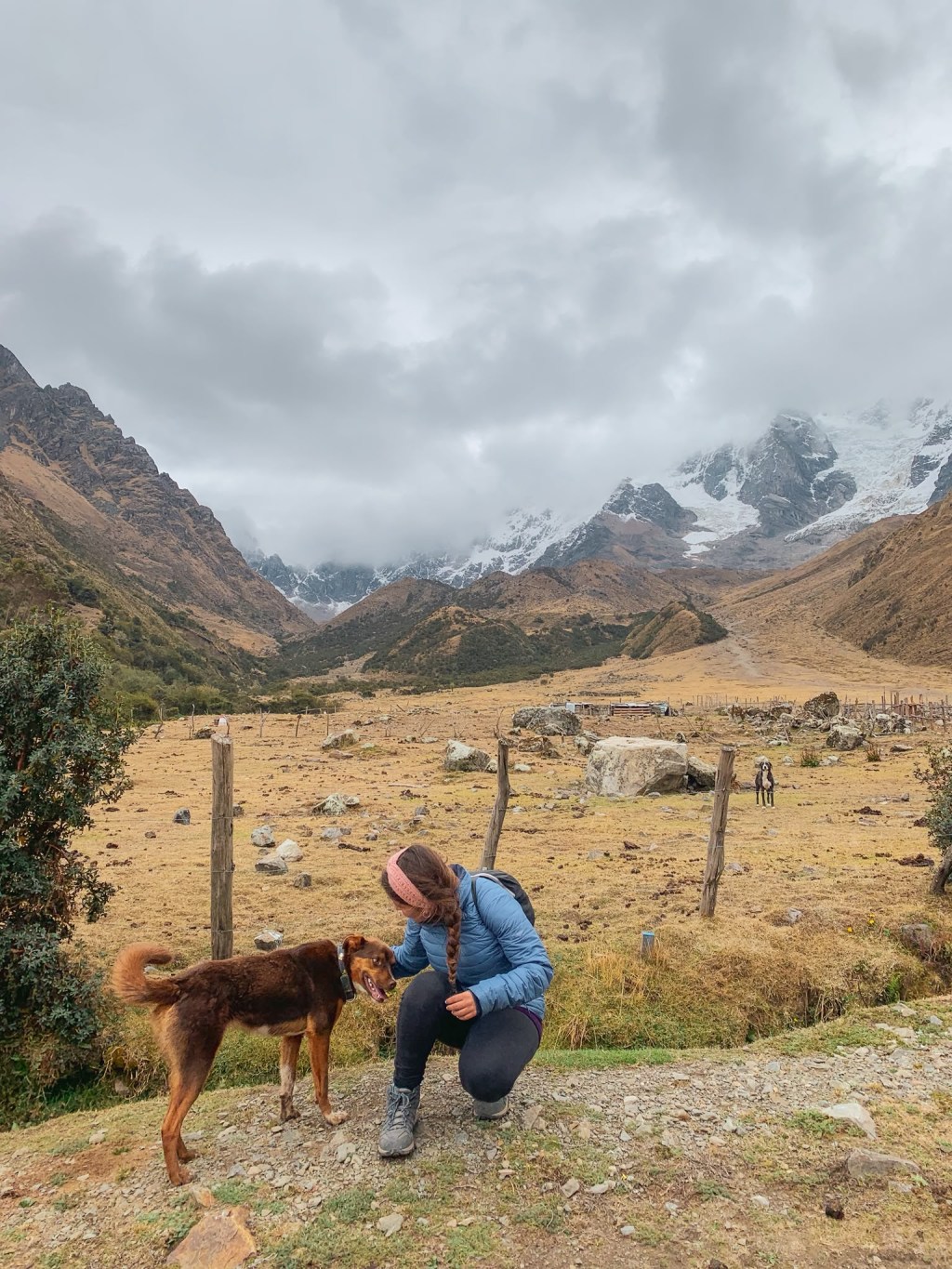
El día que conocí al Emma, no sabía su nombre; y él no sabía que yo iba a ser su madre.
Ese día era el día de Arequipa, donde nací pero no crecí.
Ese día hacía mucho frío.
Ese día empezaba una historia secundaria que no llegaría ni al desenlace.
Ese día estaba muy triste, también.
Pero no lo supe hasta mucho tiempo después, cuando comprendí qué era la tristeza y cómo se manifestaba en la adultez.
Volvamos a Emma, mi alebrije.
Íbamos trepando la montaña. Parando. Trepando un poco más. Y digo trepar porque había partes muy empinadas y todo requería mucha atención–o al menos así está dibujado en mi memoria. Quizás no. Quizás no era tanto el esfuerzo demandado, pero recuerdo que nos costaba.
Llegamos a un pueblo de 13 personas. Alguien estaba haciendo fuego y los nietos habían llegado de visita. Conocíamos el nombre de Pablo como entrada y pase libre a la cascada. Pero no fue Pablo quien nos recibió.
Tres perros grandes nos esperaban al final de la cuesta.
Uno de ellos, marrón–distintos tonos de marrón–y blanco, bajó corriendo directo hacia mis rodillas. Tuve un poco de miedo, lo admito, y lo primero que se me ocurrió fue sacar una risa nerviosa y agacharme para recibirlo con un abrazo.
Me abrazó de vuelta. Me olió las manos, movió su cola y, con ella, sus caderas, y siguió conmigo el resto del camino hasta la cumbre. Se acomodó a mis pies mientras yo contemplaba mi nuevo hogar y la inmensidad del mundo vista desde la cima de una montaña llamada Chupani.
No dejó de mirarme por horas. Yo tampoco dejé de mirarlo. Y entre el jajajá, qué divertida su expresión, parece un señor; y la constante interrogante de ¿de quién es este perrito?, le puse de nombre Emmanuel.
Pasé la noche muerta de frío y llena de esa tristeza que aún no comprendía cómo quitarme de encima, y cuando amaneció me di cuenta de que el Emma–vale la pena mencionar que uso el por una cuestión de importancia, y porque soy arequipeña–ya no estaba a los pies de la cama de paja que nos había prestado muy amablemente la Maritza, la esposa del señor Pablo a quien todavía no llegamos a conocer, ni parecía ser necesario.
Bajamos la montaña.
Yo miraba hacia atrás de tanto en tanto para ver si no se le ocurría alcanzarme para al menos despedirnos. Tal vez solo quería eso. Una despedida. Una movida de cola con movimiento de cadera incluido.
Casi dos horas después de empezado el descenso, el perrito marrón y blanco con medias despintadas en sus patitas, mentón un poco chueco y una expresión imposible de humano serio y enojado, llega corriendo justo antes de cruzar el riachuelo que marcaba el fin–o comienzo–de la caminata.
¿Qué haces acá?, le digo. Me quería quedar contigo un ratito más, me dice de vuelta.
Entonces seguimos bajando. Y avanzo, y avanza. Y en eso veo cómo se aleja de su hogar; y cómo, también, no parece importarle en lo absoluto.
Llegamos al pueblo antes de mi pueblo. El pre pueblo, o el post pueblo si lo miras al revés. Finalmente conocemos a Pablo. Lo sé porque se presenta y nos agradece por haber visitado Chupani. Hay algo en nuestros rostros que parece indicar que es allí donde efectivamente pasamos la noche. Le pregunto por Emmanuel, me dice que duerme en el puente, que no le pertenece a nadie más que a sí mismo y a la montaña.
Él sabe regresar, me dice. Y yo le creo.
Entonces llegamos a mi casa. Le abro la puerta. Pasa como si fuera un día más, un paseo menos. Se sienta al fondo del patiecito y me observa. Le doy arroz que me quedó del otro día. Se devora la olla como si no hubiera comido en meses, luego observo sus costillas que sobresalen sobre ese pelo grueso, suave y marrón que lo hacen tan único. Tal vez realmente no ha comido en mucho tiempo, pienso, qué miserable para darle arroz como primera comida de bienvenida a la civilización.
La puerta se queda abierta. Por si le apetece volver. Por si se cansa de observarme con tanta curiosidad como determinación. Pero no se va.
Por la noche se sube a la cama de una manera bastante elegante para un perrito del puente y de la montaña, y se acurruca a mi costado. Es ahí cuando comprendo cómo se va a descascarar esta tristeza que llevo en el pecho por semanas.
Al cuarto día, responde sin problema cuando lo llamo por Emma–corto de Emmanuel–para que venga a olerme las manos y moverme la cola. Entonces se acerca sin dudarlo dos veces, agacha su cabeza y entiende que soy su madre.
Ha elegido quedarse.
ENG
The day I met Emma, I didn’t know his name; and he didn’t know that I was going to be his mother.
That day was Arequipa Day, the city where I was born but never grew up.
That day was very cold.
That day, a side story was beginning that would not even make it to the ending.
That day, I was very sad, too.
But I didn’t know it until much later, when I came to understand what sadness was and how it manifested itself in adulthood.
Let’s go back to Emma, my alebrije.
We were climbing up the mountain. Stopping. Climbing a little more. And I say climbing because there were very steep parts and everything required a great deal of attention—or at least that’s how it is drawn in my memory. Perhaps not. Perhaps it wasn’t that much effort after all, but I remember that we struggled.
We reached a village of 13 people. Someone was making a fire and the grandchildren had come to visit. We knew Pablo’s name as our entry and free pass to the waterfall. But Pablo was not the one who greeted us.
Three big dogs were waiting for us at the end of the slope.
One of them, brown—different shades of brown—and white, came running straight towards my knees. I was a little scared, I admit, and the first thing that occurred to me was to let out a nervous laugh and crouch down to welcome him with a hug.
He hugged me back. He smelled my hands, wagged his tail and, with it, his hips, and stayed with me for the rest of the way to the summit. He settled at my feet while I contemplated my new home and the immensity of the world seen from the top of a mountain called Chupani.
He didn’t stop looking at me for hours. I didn’t stop looking at him either. And somewhere between hahaha, what a funny expression, he looks like a gentleman; and the constant question of who does this little dog belong to?, I named him Emmanuel.
I spent the night freezing and filled with that sadness I still didn’t understand how to shake off, and when morning came, I realised that The Emma—worth mentioning that I use The because of a matter of importance, and because I’m Arequipeña—was no longer at the foot of the straw bed that Maritza, Mr. Pablo’s wife, whom we had yet to meet, though it didn’t seem necessary to do so, had lent us.
We went down the mountain.
Every now and then, I looked back to see if he might decide to catch up with me so we could at least say goodbye. Maybe that was all I wanted. A goodbye. A wag of his tail, hips swaying along with it.
Almost two hours after we had begun the descent, the brown-and-white little dog with faded socks on his paws, a slightly crooked chin, and an expression impossible to imagine on a serious, angry human face, came running towards us just before we crossed the little stream that marked the end—or beginning—of the walk.
What are you doing here? I said to him. I wanted to stay with you a little longer, he said back.
So we kept going down. And I walk, and he walks. And then I see him moving farther and farther away from his home; and how, too, he doesn’t seem to care in the slightest.
We reached the village before my village. The pre-village, or the post-village if you look at it backwards. Finally, we met Pablo. I know because he introduced himself and thanked us for having visited Chupani. There was something in our faces that seemed to tell him that we had indeed spent the night there. I asked him about Emmanuel. He told me he slept on the bridge, that he belonged to no one but himself and the mountain.
He knows how to find his way back, he told me. And I believed him.
Then we arrived at my house. I opened the door for him. He walked in as if it were just another day, just another walk. He sat at the back of the little patio and watched me. I gave him some rice I had left over from the day before. He devoured the pot as if he hadn’t eaten in months, and then I noticed his ribs sticking out beneath that thick, soft, brown fur that made him so unique. Maybe he really hasn’t eaten in a long time, I thought, how miserable of me to give him rice as his first meal upon his arrival to civilisation.
The door stayed open. In case he felt like going back. In case he grew tired of watching me with such curiosity and determination. But he didn’t leave.
That night, he climbed onto the bed in a rather elegant manner for a little dog from the bridge and the mountain, and curled up beside me. That is when I understood how this sadness I had been carrying in my chest for weeks was going to begin to peel away.
On the fourth day, he responded without hesitation when I called him Emma—a shortened version of Emmanuel—to come smell my hands and wag his tail. Then he came towards me without a second thought, lowered his head, and understood that I was his mother.
He chose to stay.


Cuenta tu Historia